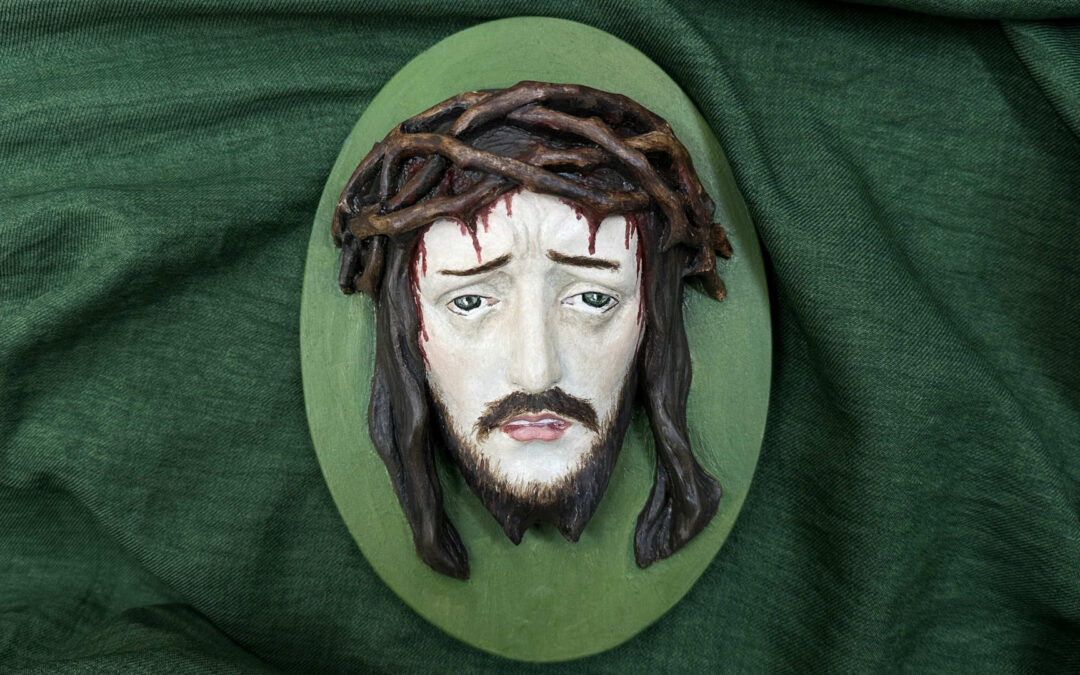
Vom Guss bis zur Fassung – Entstehung eines Christusreliefs
The English version of my blog entry can be found below.
Ein ruhiger Blick, feine Gesichtszüge und eine Oberfläche zwischen Stein, Elfenbein und Licht.
Im Entstehungsprozess eines Christusreliefs verbinden sich klassische Gussverfahren, handwerkliche Oberflächenbearbeitung und traditionelle Fassungstechniken zu einem mehrschichtigen Aufbau, bei dem Material und Farbwirkung eng miteinander verknüpft sind.
Der Reliefguss – Form und Material
Die Grundlage bildet ein Reliefguss aus Alabastergips. Dieses Material eignet sich besonders für feine Reliefarbeiten, da es selbst kleinste Details präzise wiedergibt, sich gut bearbeiten lässt und eine steinartige Oberfläche erzeugt. Je nach gewünschter Anwendung kommen in der Reliefkunst auch andere Giessmassen wie Keramikmassen, Jesmonite oder Kunstharz zum Einsatz.
Für die Herstellung wird eine Silikonform verwendet. Sie ist elastisch, langlebig und in der Lage, selbst feinste Strukturen wie Hautpartien, Haarlinien oder textile Falten detailgetreu abzubilden. Nach dem Ausgiessen und Aushärten entsteht ein formstabiles Relief, das die Grundlage für alle weiteren Arbeitsschritte bildet.
Oberfläche und Vorbereitung
Nach dem Entformen beginnt die handwerkliche Nachbearbeitung. Kanten werden geglättet, Übergänge verfeinert und die Oberfläche sorgfältig für die spätere Fassung vorbereitet.
Gips ist ein stark saugendes Material. Um diese Saugfähigkeit zu regulieren, wird traditionell eine dünne Leimschicht aufgetragen. Diese sogenannte Leimlösche reduziert die Saugfähigkeit des Gipses und schafft eine definierte Grundlage für den späteren Farbauftrag. Gleichzeitig bleibt die charakteristische Materialwirkung des Gipses erhalten.
Fassung – Farbe als Schichtsystem
Die farbliche Gestaltung einer Skulptur wird als Fassung bezeichnet. Erfolgt sie mehrfarbig, spricht man auch von Polychromie. Die Fassung ist kein einfacher Farbanstrich, sondern ein gezielter Aufbau aus Farbschichten, bei dem Form, Licht und Materialwirkung malerisch herausgearbeitet werden.
Der Farbauftrag erfolgt direkt auf die vorbereitete Oberfläche und dient der Modellierung von Tonwerten, Volumen und Lichtwirkung. Die Wirkung entsteht durch kontrollierte, meist dünn aufgetragene Farbschichten, die den plastischen Charakter des Reliefs unterstützen.
Farbmaterialien
Je nach gewünschter Wirkung kommen unterschiedliche Farbmedien zum Einsatz. Verwendet werden unter anderem Acrylfarben, Pigmente, Kreidefarben oder klassische Künstlerfarben.
Für die Fassung dieses Christusreliefs wurden mit Isopropanol verdünnte MUSSINI® Feinharz-Ölfarben von Schmincke verwendet. Durch ihren Harzanteil ermöglichen sie eine besonders differenzierte, kontrollierte Farbwirkung mit hoher Tiefe und Leuchtkraft. Die Farben lassen sich in feinen, lasurähnlichen Schichten auftragen und erlauben eine präzise Steuerung der Oberflächenwirkung.
Acrylfarben werden ebenfalls häufig verwendet, da sie schnell trocknen, gut schichtbar sind und eine hohe Kontrolle im Farbaufbau ermöglichen.
Materialwirkung und Ausdruck
Das Zusammenspiel von Material, Licht und Farbe prägt die Wirkung des Reliefs entscheidend. Jeder Arbeitsschritt – vom Guss über die Oberflächenvorbereitung bis zur finalen Fassung – trägt zur Gesamtwirkung bei.
Die Oberfläche entsteht nicht in einem einzigen Arbeitsgang, sondern entwickelt sich schrittweise durch mehrere aufeinander abgestimmte Prozesse.
Das Ergebnis ist eine lebendige Materialwirkung, bei der Licht, Schatten und plastische Form in Dialog treten.
Reliefgüsse finden zunehmend Anwendung in zeitgenössischer Kunst sowie in Interior- und Objektdesign. Ihre Verbindung von traditionellem Handwerk, mineralischen Materialien und sorgfältiger Oberflächengestaltung entspricht aktuellen Entwicklungen im materialorientierten Design.
From Casting to Surface Finishing – The Making of a Christ Relief
A calm gaze, delicate facial features, and a surface that seems to hover between stone, ivory, and light.
In the making of a Christ relief, classical casting techniques, hand-applied surface treatment, and traditional finishing methods come together in a layered process in which material and pictorial effect are closely interwoven.
The Relief Casting – Form and Material
The foundation is a relief cast in alabaster gypsum. This material is particularly suited for fine relief work, as it reproduces even the smallest details with high precision, is easy to work, and produces a stone-like surface quality. Depending on the intended application, other casting materials used in relief practice include ceramic casting compounds, Jesmonite, or resin.
For the production process, a silicone mould is used. It is flexible, durable, and capable of capturing even the finest details such as facial features, hairlines, or textile folds with high fidelity. After casting and curing, a dimensionally stable relief is obtained, forming the basis for all subsequent steps.
Surface and Preparation
After demoulding, manual surface refinement begins. Edges are cleaned, transitions are refined, and the surface is carefully prepared for the subsequent finishing process.
Gypsum is a highly absorbent material. To regulate this absorbency, a thin layer of glue size is traditionally applied. This size (German: Leimlösche) reduces the absorbency of the gypsum and creates a defined ground for the subsequent application of colour. At the same time, the characteristic material quality of the gypsum is preserved.
Finishing – Colour as a Layered System
The pictorial treatment of a sculpture is referred to as finishing or polychromy. It is not a simple application of paint, but a deliberate build-up of paint layers in which form, light, and material presence are developed pictorially.
The application of colour takes place directly on the prepared surface and serves to model tonal values, volume, and light effects. The visual result is created through controlled, mostly thin paint applications that enhance the sculptural character of the relief.
Colour Materials
Depending on the desired effect, different painting media may be used, including acrylic paints, pigments, chalk-based paints, or traditional artist’s paints.
For the finishing of this Christ relief, Schmincke MUSSINI® resin-oil colours were used, thinned with isopropanol. Due to their resin content, they allow for highly nuanced, controlled colour effects with exceptional depth and luminosity. The paints can be applied in thin, glaze-like layers, enabling precise control over surface modulation.
Acrylic paints are also commonly used, as they dry quickly, are easily layered, and allow for a high degree of control in the build-up of colour.
Material Effect and Expression
The interplay of material, light, and colour is decisive for the overall effect of the relief. Each stage – from casting to surface preparation and final finishing – contributes to the final appearance.
The surface does not emerge in a single step but develops gradually through several carefully coordinated processes. The result is a living material presence in which light, shadow, and sculptural form enter into dialogue.
Relief casts are increasingly used in contemporary art as well as in interior and object design. Their combination of traditional craftsmanship, mineral materials, and carefully considered surface treatment reflects current developments in material-oriented design.
Neueste Kommentare